pre-ipo
Exited




Palantir Technologies was founded in 2003 by Alex Karp, Peter Thiel, Stephen Cohen, Joe Lonsdale, and Nathan Gettings, and is headquartered in Denver, Colorado. The company builds software platforms that enable organizations to integrate, manage, and analyze massive datasets for operational decision-making — operating at the intersection of artificial intelligence and institutional data infrastructure.
Palantir's origins are in intelligence analysis for the U.S. government, where its Gotham platform became the backbone of data operations for the CIA, NSA, and Pentagon. Over the past decade, the company expanded into the commercial sector through its Foundry platform, and more recently has emerged as a leading enterprise AI deployment platform through its Artificial Intelligence Platform (AIP).
The company went public via direct listing on the NYSE in September 2020 under ticker PLTR. What was once viewed as a niche government contractor has transformed into one of the most closely watched AI growth stocks, with ten consecutive quarters of revenue growth acceleration and a market capitalization of approximately $325 billion as of April 2026.
Palantir's Q4 2025 results marked a breakout moment. Revenue reached $1.4 billion (up 70% YoY) — the highest growth rate in the company's history as a public company. Full-year 2025 revenue totaled $4.475 billion, up 56% YoY, with GAAP net income of $1.625 billion. The Rule of 40 score hit a record 114, placing Palantir among the most capital-efficient enterprise software companies in the world.
The growth engine is increasingly the commercial sector. U.S. commercial revenue surged 137% YoY in Q4 to $507 million, driven by rapid enterprise adoption of AIP. U.S. government revenue grew 66% to $570 million. Total U.S. revenue exceeded $1 billion in a single quarter for the first time. The customer base grew 34% YoY to 954 clients, and Palantir closed 180 deals above $1 million in Q4 — including 84 above $5 million and 61 above $10 million.
Total contract value hit a record $4.3 billion in Q4, while remaining deal value surged 145% to $4.4 billion — providing strong forward revenue visibility. Management guided 2026 revenue of approximately $7.19 billion at the midpoint, implying 61% growth, with U.S. commercial expected to exceed $3.14 billion (at least 115% growth).
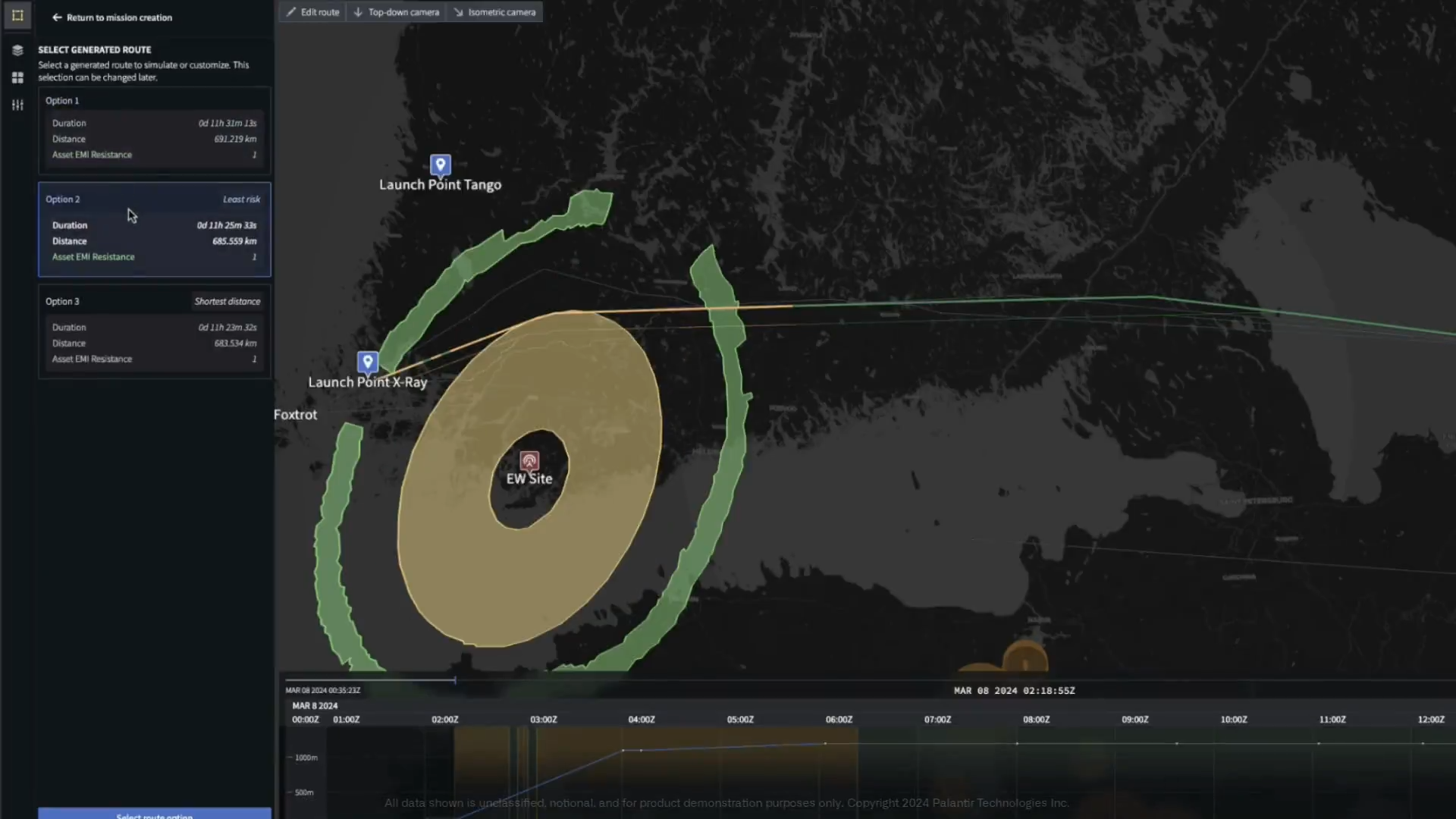
AIP — Palantir's Artificial Intelligence Platform — is the catalyst. AIP enables enterprises to deploy large language models directly within existing data infrastructure, delivering actionable AI results in production environments rather than pilot projects. The "boot camp" sales motion — compressed workshops where companies see immediate, measurable ROI — has produced rapid conversions to multi-year contracts. This motion did not exist two years ago and now generates more than half a billion dollars per quarter.
On the government side, Palantir's moat runs extraordinarily deep. The Gotham platform is embedded in mission-critical operations across the Pentagon, intelligence community, Space Force, and allied defense agencies at the highest classification levels. The U.S. Army awarded an Enterprise Service Agreement valued at up to $10 billion over 10 years, consolidating 75 previously separate data and software contracts. The company has secured over $900 million in recent federal contracts spanning the Army, ICE, IRS, Space Force, and Treasury. The UK Ministry of Defence awarded a £240 million contract in December 2025, and the UK Financial Conduct Authority selected Palantir for sensitive regulatory data in March 2026.
Enterprise partnerships are scaling rapidly. In March 2026, GE Aerospace expanded a multi-year partnership to deploy agentic AI across military aviation sustainment and live production systems. Stellantis renewed and expanded to a five-year supply chain optimization agreement. Bain & Company expanded its partnership to embed AIP into consulting engagements.
The valuation debate is fierce. At approximately $325 billion market cap, Palantir trades at a forward P/E of roughly 99x and forward P/S of approximately 49x based on 2026 guidance. Bulls argue Palantir is the only enterprise software company with simultaneous government lock-in at classified levels and ten consecutive quarters of accelerating growth. Bears, including Michael Burry who took a high-profile short position, argue the multiple prices in near-perfect execution. The stock has dropped approximately 31% from its November 2025 peak.
Palantir is led by co-founder Alex Karp, who has served as CEO since founding. Karp, a Stanford Law graduate with a Ph.D. in philosophy from Goethe University Frankfurt, is an unconventional tech CEO known for his intense focus on product-market fit in government and defense, and his philosophical approach to technology's role in democratic societies.
Co-founder Peter Thiel, the PayPal co-founder and prominent venture capitalist, remains the company's largest individual shareholder and a board member. Ryan Taylor serves as Chief Revenue Officer and Chief Legal Officer, describing Q4 2025 as "nothing short of historic, capping off a monumental year." The company employs over 3,700 people globally.
Publicly traded on the NYSE under ticker PLTR. Key early investors included Peter Thiel (co-founder), In-Q-Tel (CIA's venture arm), Founders Fund, and Tiger Global Management. The company raised approximately $3 billion in private funding before its September 2020 direct listing at $7.25 per share. As of April 2026, the stock trades at approximately $135 per share with a market cap of roughly $325 billion.
Palantir operates three core platforms. Gotham serves intelligence and defense agencies at the highest classification levels. Foundry serves commercial enterprises with data integration, analytics, and AI. AIP sits on top of both, enabling LLM and AI agent deployment within existing Palantir environments.
The government moat is uniquely defensible. Platforms are embedded in long-term, mission-critical contracts with high renewal rates across the Pentagon, intelligence community, DHS, ICE, IRS, Space Force, and NATO allies. These use cases are difficult and costly to replace. The "land-and-expand" dynamic boosts annual recurring revenue without requiring constant new customer acquisition. DoD's total AI budget is projected to exceed $40 billion annually by 2028, and Palantir's Maven designation gives it incumbent advantage across combatant commands.
Palantir's valuation trajectory as a public company: $15.8 billion at September 2020 direct listing → approximately $45 billion peak in early 2021 → $10 billion trough in early 2023 → $325 billion as of April 2026. The S&P 500 inclusion in September 2024 catalyzed institutional buying, and AIP-driven growth acceleration propelled the stock from under $20 to over $120 in roughly 18 months.
The company generates strong free cash flow (56% adjusted FCF margin in Q4 2025) and carries approximately $6.2 billion in net cash.
Q: Is Palantir's growth sustainable at these rates?
A: Palantir has delivered ten consecutive quarters of revenue growth acceleration — extremely rare in enterprise software. The $4.4 billion in remaining deal value provides substantial forward visibility. However, sustaining 60%+ growth at a $7+ billion revenue base would be historically unprecedented, and international growth remains challenged. Q1 2026 earnings on May 4 — specifically U.S. commercial revenue — will be a critical signal.
Q: What is the "boot camp" sales model?
A: AIP boot camps are compressed, hands-on workshops (typically 1-5 days) where enterprise customers bring their own data and see real AI-powered results using Palantir's platform. Unlike traditional enterprise pilots that take months, boot camps create immediate "aha moments" that lead to rapid contract conversions. This motion is now generating over $500 million per quarter and did not exist before 2023.
Q: What are the main risks?
A: Key risks include an extremely rich valuation (forward P/E ~99x) that requires near-flawless execution, Michael Burry's high-profile short position, limited international growth, dependence on U.S. government spending priorities, competition from Snowflake, Databricks, and hyperscaler AI offerings, and Alex Karp's unique management style. The 31% decline from November 2025 highs demonstrates the stock's volatility when sentiment shifts.
Q: Is Palantir overvalued?
A: This is the central debate. At ~49x forward P/S, Palantir trades at nine times the enterprise software sector median. Bulls point to the only dual government-commercial AI platform with classified access and accelerating growth. Bears point to the multiple requiring sustained 60%+ growth that few companies in history have achieved. The answer likely depends on whether AIP adoption continues its current trajectory or decelerates as the addressable market saturates.




%201%20(1).png)