pre-ipo
Exited




Lyft, Inc. was founded in 2012 by Logan Green and John Zimmer and is headquartered in San Francisco, California. The company operates a peer-to-peer ridesharing and multimodal transportation platform serving 644 U.S. cities and 12 Canadian cities, providing on-demand rides, bike and scooter rentals, and increasingly positioning itself as a platform for autonomous vehicle deployment.
Lyft went public in March 2019, ahead of rival Uber, and trades on the NASDAQ under ticker LYFT. The company has undergone a leadership transition, with David Risher taking over as CEO in 2023, bringing renewed focus on operational efficiency, rider experience, and disciplined cost management.
The U.S. rideshare market has matured significantly. The fare subsidies and driver incentive wars that defined the post-pandemic recovery have given way to what analysts describe as a "rationalized pricing" environment — a structural shift that benefits Lyft's unit economics and margin profile.
Lyft reported full-year 2025 revenue of $6.3 billion, up 9% year-over-year, with record adjusted EBITDA performance. The fourth quarter was particularly strong: gross bookings reached $5.08 billion (up 18.7% YoY), with gross bookings per ride increasing 6%, indicating the company is capturing more revenue per trip without sacrificing ride volume.
The company's 2025 GAAP net income of $2.8 billion requires context: this figure was substantially supported by a $2.9 billion one-time tax benefit. Stripping out the tax event, Lyft's underlying profitability trajectory still shows meaningful improvement, with record quarterly adjusted EBITDA and take rate expansion.
Lyft holds approximately 24-29% of the U.S. rideshare market, with Uber commanding the remainder. Lyft has been narrowing the gap through consecutive quarters of rides and revenue growth, particularly in underpenetrated markets. Average revenue per active rider reached $55.85 in Q4 2024, improving year-over-year. The platform maintains over 500,000 weekly active drivers.
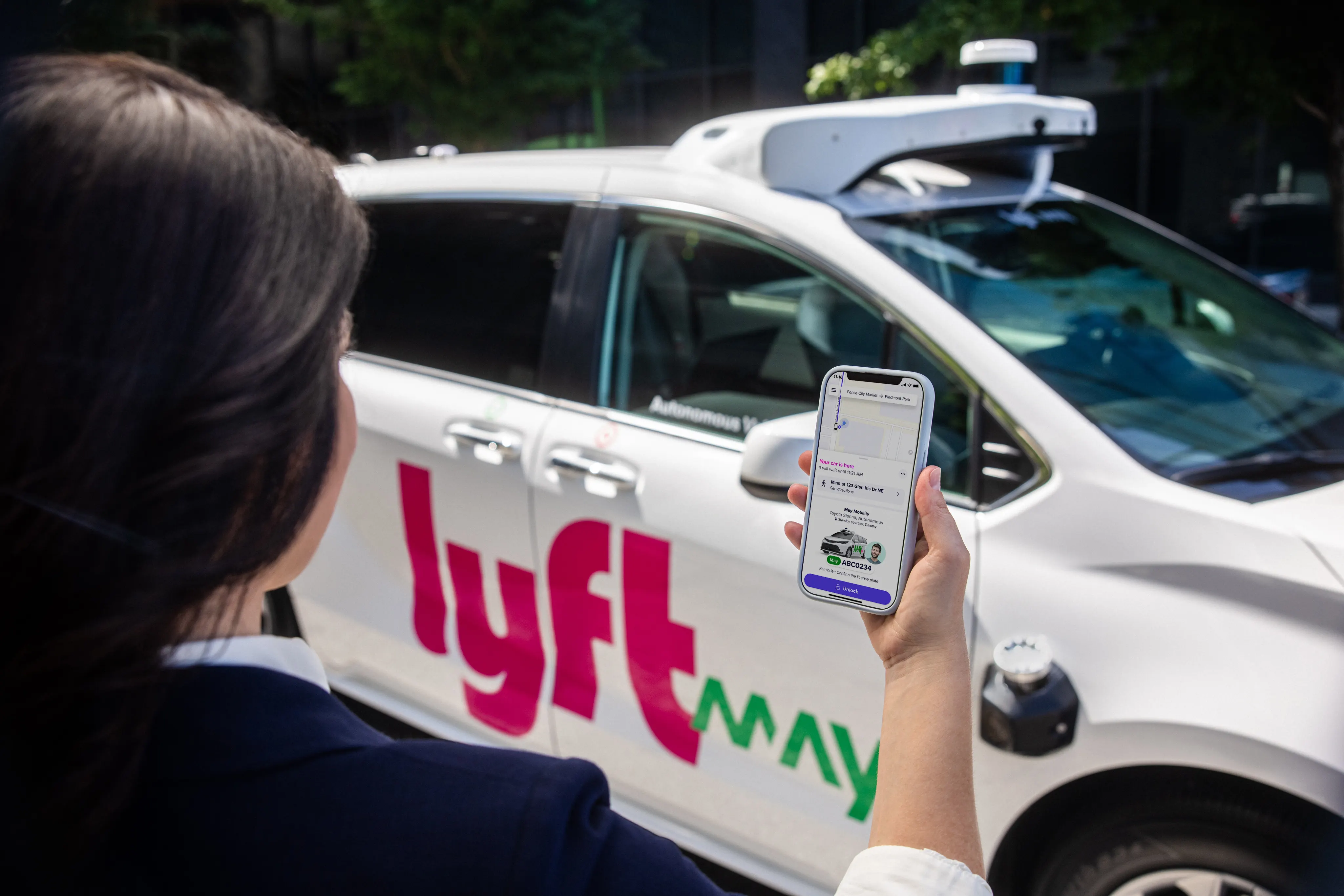
Lyft's autonomous vehicle strategy centers on being the platform layer rather than building proprietary self-driving technology. After selling its Level 5 AV division to Toyota's Woven Planet in 2021, Lyft now pursues partnerships with AV companies — providing the ride network, customer demand, and routing infrastructure that autonomous fleets need to deploy at scale.
David Risher has served as CEO since April 2023, succeeding co-founders Logan Green and John Zimmer who transitioned to board roles. Risher, a former Amazon executive (employee #37) and later president of Worldreader, brought a back-to-basics operational philosophy that prioritized rider experience, driver satisfaction, and cost discipline over growth at all costs.
Under Risher's leadership, Lyft has streamlined operations, reduced corporate headcount, refocused on its core rideshare product, and delivered consecutive quarters of improving unit economics.
Publicly traded on NASDAQ under ticker LYFT. Key pre-IPO investors included Andreessen Horowitz (led the Series A), Alphabet's CapitalG, Fidelity Investments, Rakuten, Alibaba, and Mayfield Fund. The company went public in March 2019 at $72 per share.
The U.S. rideshare market is effectively a duopoly between Uber (71-76% share) and Lyft (24-29% share). While Uber's global diversification gives it significantly larger total revenue ($44 billion+ in 2024), Lyft's U.S.-focused strategy allows concentrated operational execution and avoids the complexity of international regulatory environments.
Both companies have moved away from the unsustainable subsidy-driven model, allowing take rates to expand industry-wide. In NYC, Uber and Lyft together handle approximately 5x more daily trips than yellow cabs (634,000 vs. 126,000), holding a combined 75.1% share of all legal for-hire transportation.
The autonomous vehicle transition represents both Lyft's greatest long-term opportunity and risk. As a platform play, Lyft avoids the billions in R&D required to develop self-driving technology but also cedes control over the pace of AV deployment to its partners.
Lyft's revenue has recovered strongly: $2.36 billion (2020) → $3.21 billion (2021) → $4.10 billion (2022) → $4.40 billion (2023) → $5.79 billion (2024, +32% YoY) → $6.30 billion (2025, +9% YoY). The company's compound annual growth rate from 2020-2024 was approximately 25%.
Revenue growth decelerated to 9% in 2025 as the market matured, but the quality of revenue improved significantly — higher take rates, better driver utilization, and reduced incentive spending mean more of each dollar flows to the bottom line.
Q: Can Lyft compete effectively against Uber long-term?
A: Lyft's competitive position has stabilized in the 24-29% range, and the rationalized pricing environment means market share battles are no longer fought through unsustainable subsidies. The key question is whether autonomous vehicles disrupt the current duopoly — if Lyft successfully positions itself as the deployment platform for AV partners, it could maintain or grow share without the capital burden of proprietary self-driving technology.
Q: How does Lyft's autonomous vehicle strategy work?
A: After selling its in-house AV division to Toyota's Woven Planet in 2021, Lyft pivoted to an asset-light platform strategy. Rather than spending billions developing self-driving technology, Lyft provides the ride network, customer demand, routing infrastructure, and payment systems that AV companies need to deploy commercially. This preserves capital and reduces R&D risk.
Q: What are the main risks?
A: Key risks include Uber's dominant market position, the uncertain timeline of autonomous vehicle deployment, regulatory risks (driver classification, insurance requirements), the one-time nature of the $2.9 billion tax benefit that inflated 2025 net income, and lack of revenue diversification beyond U.S./Canada rideshare. If AV technology providers choose to build their own ride networks rather than partner with existing platforms, Lyft's positioning could weaken significantly.




%201%20(1).png)